Wednesday MidDay Medley
Produced and Hosted by Mark Manning
90.1 FM KKFI – Kansas City Community Radio
TEN to NOON Wednesdays – Streaming at KKFI.org
Wednesday, November 18, 2026
WMM presents Dwight Frizzell & WAY BEYOND THE BLACK CRACK – A 50th Anniversary Program
- Various Artists – Main Title (Insgrumental)“It’s Showtime Folks”
from: Motion Picture Soundtrack to All That Jazz / Universal / Dec. 20, 1979
[WMM’s theme] - BCR – “Spiral Galaxy excerpt”
Spiral Galaxy, BCR in 1982 with this recording from their first performance on February 13, 1982 in Epperson Auditorium, Kansas City, Missouri.
Cliff Baldwin – voice, tenor sax, percussion
Rodney Franks – congas
Dwight Frizzell – clarinet, animal calls, percussion
Ed Herrmann – Serge synthesizer, bass
Olson Marin – congas
Allaudin Ottinger – drums, percussion, vocal
Chuck Reynolds – steel drums
Valerie Smith – trumpet, voice, percussion
10:00 – Show Intro
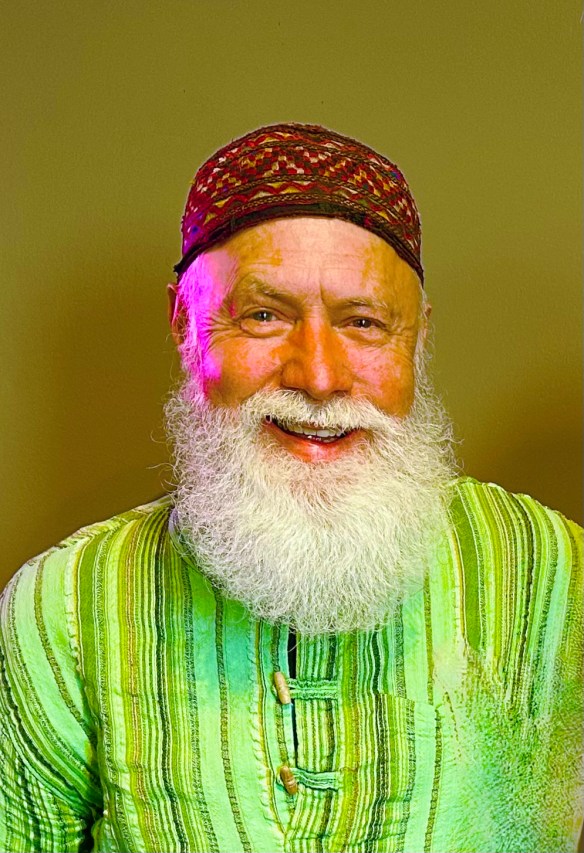
In 1976 Dwight Frizzell released Beyond the Black Crack, an album featuring the first publication of music based on the physics of black holes. Today, 50 years later, it is recognized as a significant and exhilarating experience in modern experimental music. “If the idea of Sun Ra’s Arkestra jamming with electric-era Miles Davis and Frank Zappa on some distant burnt-out asteroid appeals, then this could be for you.” —Top magazine. This special radio show explores Dwight’s journey after the record came out, picking things up in 1979 as he began working with world class artists featuring luminaries that joined the fold like Wavy Gravy, Francis Ford Coppola, David Ossman, Star Trek composer Michael Henry, Dr. Demento and Harry Truman. The show includes lots of BCR tracks including a rarity recorded in 1985 while warming up for Sun Ra. There is also an amazing story about Oscar Pettiford in Kansas City, and Soprano Patricia Johnson.
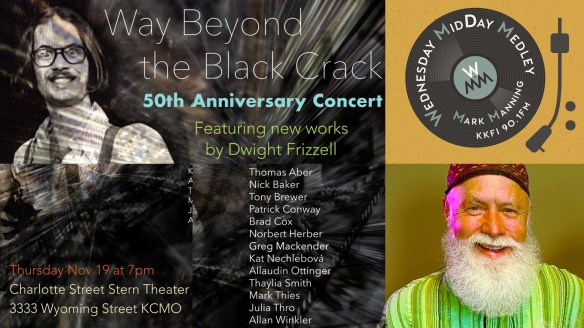
BCR plays WAY BEYOND THE BLACK CRACK – 50th Anniversary Concert Thursday, November 19, at 7:00pm at Charlotte Street Stern Theater, 3333 Wyoming Street, KCMO featuring new works by Dwight Frizzell and featuring: Thomas Aber, Nick Baker, Tony Brewer, Patrick Conway, Brad Cox, Norbert Herber, Greg Mackender, Kat Nechlebocá, Allaudin Ottinger, Thaylia Smith, Mark Thies, Julia Thro and Allan Winkler.
Soprano Patricia Johnson will be singing with BCR when the band plays The Ship, 1221 Union Ave. KCMO, on Saturday, December 19 at 6:00pm.
Rev. Dwight Frizzell is a Professor & Sound Head, at Kansas City Art Institute, in the Photography & Filmmaking Department. He is an internationally recognized artist whose work combines video, performance, installation, music, audio art, and writing. Frizzell’s work about his boyhood neighbor, Harry S. Truman, was featured in the Peabody-awarded “Lost and Found Sound” series broadcast on National Public Radio. Frizzell has produced an opera based on the life of Charles Darwin. In addition to his B.F.A. degree from KCAI, he holds a terminal fine arts degree in Sound Design from the UMKC. Frizzell also served as the very first Editor of The Pitch, he is a founding member of the newEar contemporary chamber ensemble, and is host & producer of “From Arc To Microchip” heard on the fifth Thursday of each month on KKFI’s Thursday Night Special at 7:00pm on 90.1 FM.
Rev Dwight Frizzell Thanks for being with us again on WMM
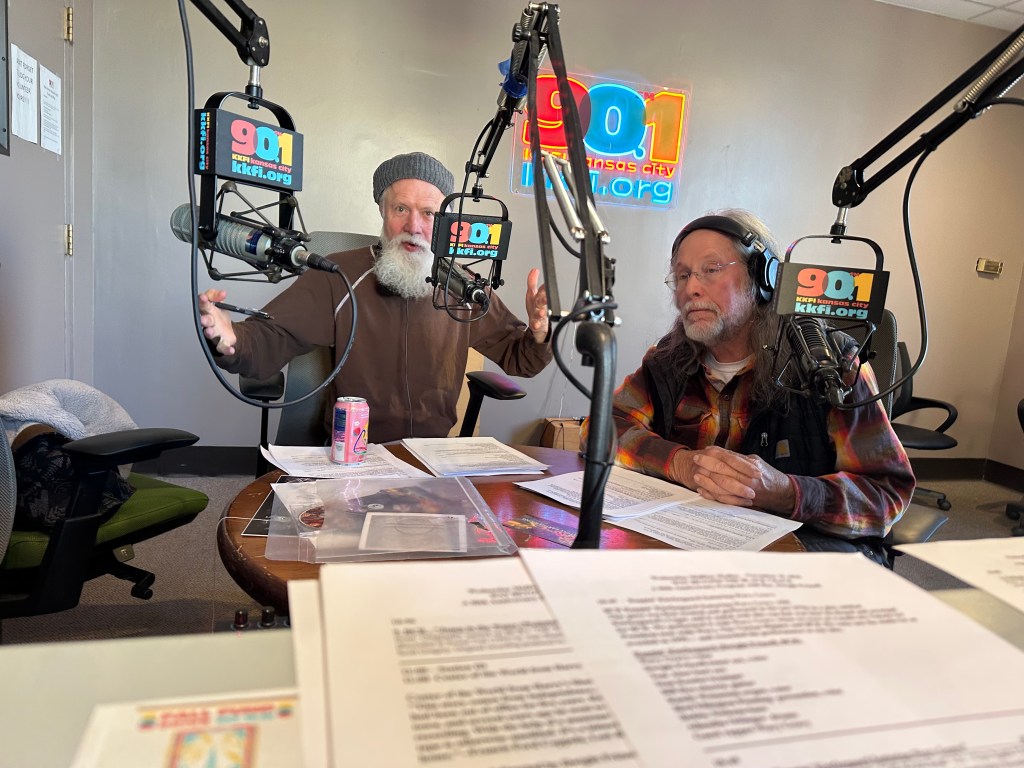
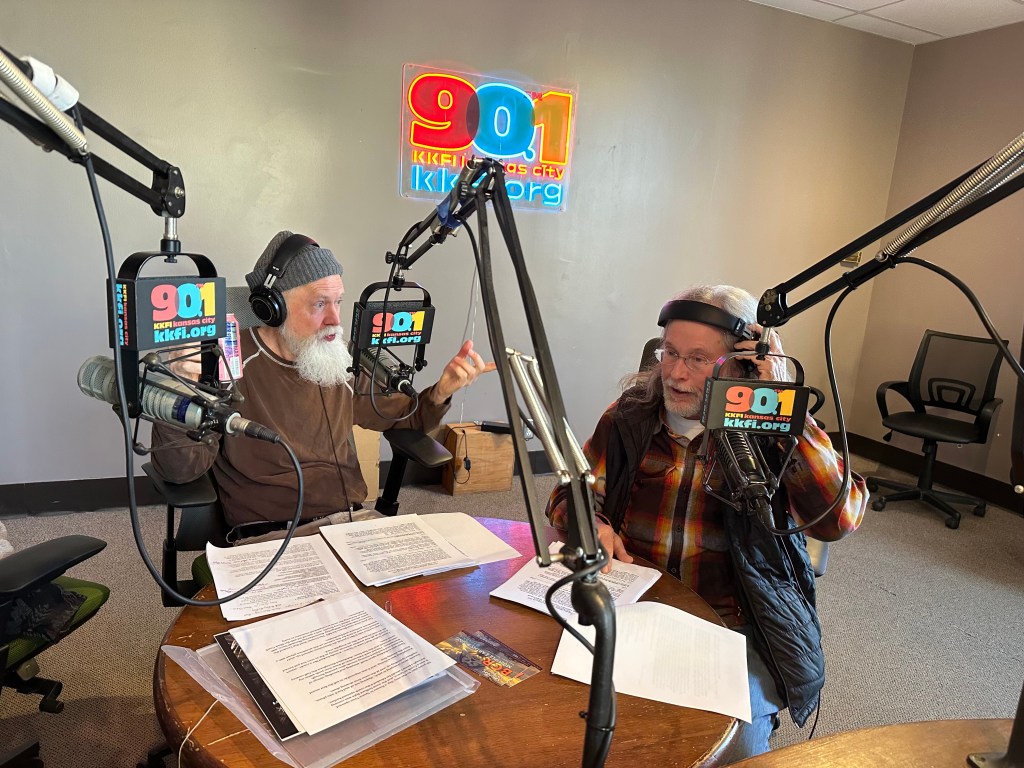
Dwight invited BCR bandmate Alauddin Ottinger to join u on the radio show.
10:05 – OPUS – “Riding the Waves”
OPUS – “Riding the Waves” was a precursor to BCR. Dwight began working with professional musicians after Beyond the Black Crack was released — this was where Dwight first began playing regularly with Alauddin Ottinger.
Riding the Airwaves is by OPUS, a new music collective based in Lawrence, Kansas.
Recorded live on KOPN-FM March 18, 1981 on Ionisations hosted by Ed Herrmann,
recorded by Ed Herrmann and Chris Merrick, produced by Dwight Frizzell
Players: Bill Oldfather-bassoon, John Oldfather-French horn, Joanie Harrell- guitar, Dwight Frizzell – bass clarinet, Donna Gilliam – flute, Barry Bernstein – bass, Alladdin Ottinger – drums, percussion, Dr. Leon Burke III – whistle, conduction, percussion
10:11
- OPUS – “Riding the Waves (edit)”
Recorded live on KOPN-FM March 18, 1981 on Ionisations hosted by Ed Herrmann
10:17 – Rue du Cirque (Frizzell) 1982 – 1995
BCR – Rue du Cirque (Frizzell) 1982 – 1995
A lost love song composed in Paris, France in October 1982 and recorded later in
1995. It was performed with lyrics and sung by Patricia Johnson at the Ship on
October 24, 2026 and will be included on the December 19, 2026 BCR show also at the Ship.
The lyrics and recited poem from ’82 are below—noting the soloists on the recording
are Dwight – clarinet, Randy Weinstein – harmonica, Bill Dye – guitar, Bird Ellington
Fleming – congas.
Randy Weinstein-harmonica, percussion
Dwight Frizzell-clarinet
Thomas Aber-alto sax
Bill Dye-electric and acoustic guitars
Bird Ellington Fleming-organ, voice
Bobby Nickens-bass
Allaudin Ottinger- drums
Solos Dwight Frizzell-clarinet, Randy Weinstein-harmonica, Bill Dye-acoustic guitar,
Bird Ellington Fleming-congas
10:21
- BCR – “Rue du Cirque” (Frizzell) (1982 – 1995)
Originally issued on BCR’s “Off-World Beat” CD (City Spark CDJ 334) in 1995.
Recorded at Sound Trek (1995) by John Blank. Mixed at Conservatory Recording by Scott Gregory. Original recording produced by Tom Mardikes. ©1983 Dwight Frizzell
(Clarinet & guitar phase 1—up and under)
I walked all night and kept walking,
from Maison Blanche to Montmarte,
Holding close the fears you have only for me, Passing beneath the damp eye-lids
of some ancient time
long forgotten underground…
(Clarinet & guitar phase 2—up and under)
The light shifted on Paris where the half-moon frosted the stony eyes of thousands of
saints stacked to the stars.
Even the Quasimodo Snack Bar was closed. And where were you?
A woman with a ragged necktie lit a cigarette. Her breath hung as a mist reflecting in the Seine.
(Clarinet & guitar phase 3—up and under)
The laws of sky and earth were hushed
in the endless streets of Paris.
You said you would meet me there beneath the tower on Rue du Cirque.
(Clarinet & guitar phase 4—wrap up)
Sung CHORUS (DF cues)
A rose, a key, a glove A sign, for me, above
The night tower glistens Where are you?
VERSE
Rue du Cirque The night is falling On Rue du Cirque
Rue du Cirque
My heart is sinking On Rue du Cirque
CHORUS
A rose, a key, a glove A sign, for me, above
The night tower glistens Where are you?
(solo section, conga solo, cue to VERSE, CHORUS out)
10:25
- BCR – “Robot Lips (written by / lead vocals: Jeff Rendlen)
from: Dr. Demento / 1987 / 1988
Jeff Rendlen-lead, vocal bass
Randy Weinstein-harmonica, vocal, keyboards
Dwight Frizzell-tenor sax, vocal
Thomas Aber-alto sax
Bill Dye-electric guitar
Bird Ellington Fleming-percussion
Allaudin Ottinger- drums, vocal
Solos Thomas Aber-alto sax, Randy Weinstein-harmonica, Dwight Frizzell-tenor sax
BCR and Robot Lips on Dr. Demento 1988 – Our national appearance on Dr. Demento’s show— a robot-love song with a bulb bash sequence in the middle of it — noting that’s when I first met Allaudin (during a live performance of Jeff Rendlen’s Bash for Three Mashers in 1979.
The bulb bash concrete episode was created by Jeff Rendlen. It was inspired by Rendlen’s former composition, “Bash for Three Mashers (or Panacia for Pop, Implosive Pre-ferences),” in which the vacuum tubes in over two hundred light bulbs, florescent tubes, and televisions were broken according to a highly articulated score. “This started as a sound sculpture. Mechanical methods of breaking were to be used. A salvage operation from the unsuccessful sculpture event, mostly mechanical. Through the suggestions of Rev. Frizzell, the performance in place of a sculpture is used, the results of which I hope to follow with a bulbustium symphony.”–Jeff Rendlen, 1979. “Implosive Preferences” was broadcast on Radio Nova in Paris, France in November, 1982. “Robot Lips” was broadcast on Dr. Demento’s nationally syndicated radio show on June 25-26, 1988. It was also select-ed by Andy Dunkley (Rockpool) for inclusion in the New Music Seminar’s compilation of unsigned bands in New York City July 15, 1988.
10:30 – Underwriting
10:31 – Breakfast Atiphonal
BCR – Breakfast Atiphonal (Rendlen) – This live track was recorded in performance at Parody Hall in our warm up set for Sun Ra. The tune was composed by Jeff Rendlen, and we rehearsed it in his loft at 3925 Main. The piece was delicated to acoustic bass player Oscar Pettiford. A few months after we had diligently practiced this composition— an article about KC jazz history was published in the Kansas City Star with a story about some after hours jazz players getting arrested during a raid at the loft at 3925 Main— and one of them was Oscar Pettiford!
10:37
- BCR – “Breakfast Atiphonal (Rendlen)”
from: Recorded LIVE at Parody Hall in warm up set for Sun Ra / 1985
10:44 – INK David Ossman with Judith Walcutt & Michael Henry 2020
INK David Ossman with Judith Walcutt & Michael Henry 2020
I began working with David Ossman in the late 1970s through the Midwest Radio
Theater Workshop. Before BCR I had a performance group, the From Too Ensemble,
that was more theatrical than BCR— we performed radio and staged plays— Dr. Fogg,
Mysterious Invasion of Thick Necks from Outer Space, Space Egg, Bestiality Tango—
with the Firesign Theater and Kurt Weill influences.
INK is an Audio Timecapsule sourced from a 19th century reading primer.
10:49
- David Ossman with Judith Walcutt & Michael Henry – “INK”
from: Midwest Radio Theater Workshop / 2020
10:51 – Rappin’ Kierkegaard featuring Wavy Gravy
BCR Rappin’ Kierkegaard featuring Wavy Gravy 1995
This piece was first created and performed in the late 1970s in a play entitled
Kierkegaard’s Cigar, and it ended with this rap that was later developed and arranged
for BCR. We performed it with Wavy Gravy when we were on a multi-city Nobody for
President tour with Wavy, The Vicious Hippies and BCR. He came into the studio for an
overdub in 1995— and recorded his performance in one take.
Rappin’ Kierkegaard (Dwight Frizzell, BCR)
Wavy Gravy-voice
Dwight Frizzell-tenor sax, voice
Tom Aber-bari sax
Stan Kessler-trumpet
Bill Dye-electric guitar
Randy Weinstein-organ, voice
Bird Ellington Fleming- percussion, voice
Bobby Nickens-bass
Allaudin Ottinger- drums
Guest rapper-Wavy Gravy
10:56
- BCR – “Rappin’ Kierkegaard featuring Wavy Gravy”
from: Originally issued on BCR’s “Off-World Beat” CD / City Spark CDJ 334 / 1995
[Recorded at Sound Trek (1995) by John Blank. Mixed at Conservatory Recording by
Scott Gregory. Original recording produced by Tom Mardikes. ©1986 Dwight Frizzell, BCR]
11:00 – Station ID
11:00 Center of the World from Harry’s Shadow 1996
Center of the World from Harry’s Shadow 1996
“This story comes from Independence, Missouri, September 12, 1957. Harry S. Truman
had been out of office for five years. Rev. Dwight Frizzell grew up in Truman’s home
town, and several years ago he went to the Truman Presidential Library and found this
recording. With the help of a musician friend, Michael Henry, he added music. But the
tape is otherwise unedited. It’s a bittersweet goodbye by a famous man to his boyhood
home.”–Francis Ford Coppola, Lost & Found Sound
Written and directed by Dwight Frizzell
Speech by Harry S. Truman
Music by Michael Henry
Video shot by Tony Allard
Video edited by Rhondda Francis
Audio mix by Dwight Frizzell
Harry’s Shadow – Experimental documentary in radio and video versions, 1997
“‘Harry’s Shadow’ isn’t exactly Truman lite: The Rev. Dwight Frizzell’s film about the man from Independence includes some unsettling contrast. “You could say that the
Rev. Dwight Frizzell has spent a quarter-century working on his new film, ‘Harry’s
Shadow.’ “A series of short films stitched together into a 29-minute opus, ‘Harry’s
Shadow’ explores, in a style that can be solemn but more often veers into the absurd,
what it was like growing up as Harry Truman’s neighbor.
“As a teenager in Independence, Frizzell took copious home movies of Truman’s
funeral in 1972, then later stole garbage from outside the Truman home. “‘I wouldn’t say I’m obsessed with Truman,’ said Frizzell, who has kept busy on the local arts scene and whose newEar chamber ensemble is heard on the soundtrack. ‘But he’s always
been someone who’s been in the back of my mind.’
‘Harry’s Shadow,’ which was completed with a grant from the Missouri Arts Council, is
told in a personal style and is often darkly funny. (The footage young Dwight took at the funeral is not exactly reverent.) “Frizzell also incorporates archival material from the Truman Library and his own collection, video taken of the RLDS Temple in
Independence, and even some improvised whistling…in an attempt to include one of
Truman’s most notorious habits in the film.
“…’He was revered by the community and I respected him,’ Frizzell said. ‘But there was always part of me that was ambivalent because my neighbor had dropped the atomic
bomb.’
“The film’s highlight is a short piece centered on Truman Corners, which grafts the
words of the ex-president at a 1957 dedication of the Grandview shopping center onto
less-than-flattering images Frizzell recently shot there. It’s funny and poignant all at once. ‘It’s marginal history, but it tells us a lot about Harry,’ Frizzell said. ‘Here is the place that was his boyhood home and helped shape his character, and he comes back to it and it’s all covered with asphalt. You can hear the disorientation in his voice.”— Aaron Barnhart, The Kansas City Star
This work was included in the Lost & Found Sound series that received a Peabody
Award. Center of the World ©1997 Dwight Frizzell
11:09
- Harry S. Truman Dwight Frizzell – “Center of the World ”
from: Harry’s Shadow / Lost and Found Sound / 1996
11:14 – Father Hogan’s Account
Father Hogan’s Account from Irish Wilderness 2003
The Irish Wilderness: A Phantasmic Meditation (based on the writings of John Joseph
Hogan) for actor, organ or accordion, lute or guitar, bodhran, bagpipes, animal call
vocalist, hydrophonic metal instrument, digital processors, Ozark ambiences, 6‐
channel sound
“Part composition, part hörspiel, Frizzell’s concept of historiophony‐‐using historic and/or field recordings to relate the history of a period or place—is the logical continuationof Charles Ives’ work…The Irish Wilderness uses field recordings of the ‘wondrous springs’ of Ripley and Oregon counties, Missouri, interleaved with traditional tunes known to the Irish Catholics (circa 1859) to document the tragic history of the Irish settlers…”‐‐Dan Warburton, Signal to Noise
Project Background
The Irish Wilderness is a densely wooded area in the Ozarks of southwest Missouri,
located between the Eleven Point and Current Rivers in Ripley and Oregon counties,
not far from Greer Springs and West Plains. Its enormous bio‐diversity and karst
topography veil any remnant of the murderous fate of the fifty Irish Catholic families who thrived here in the mid‐ninteenth century. See History & Locales.
For the 2003 National Audio Theatre production, the biologically and geologically
diverse soundscape of this area was captured by two teams of adventurer/recordists
(led by Jim Metzner and Renee Pringle) and then imaged in 6.1 channel sound. The
rush and swell of the Eleven Point River rapids, cavernous drips in White’s Cave,
underground splatter sequences in Devil’s Well, nocturnal insects, and bullfrog’s at
White’s Creek were digitally intertwined with fragments of traditional tunes known to
the Irish Catholics (circa 1859) who settled here.
In sonic séance, the music of these people was spectrally mapped and used to filter
the soundscape impressions. The frequencies in the acordian melody “St. Patrick’s
Breastplate,” for example, were removed from the sound of the river rapids. The
melody was audible only through its absence in the water’s sound. At other times, the
spectral image of a guitar sparkled through a waterfall or smeared cricket chirps into an electrolized soup. The intrusive sounds of war and industry were triggered by the live traditional musicians, who shaped and carved out the 6‐channel audio‐space.
A first‐hand account of the rise and dissemination of the Irish Catholic community at
Wilderness, Missouri, penned by Father John Hogan, the poet‐priest, was used to
introduce and dramatize the soundscape composition.
A Short History of the Irish Wilderness
When John Joseph Hogan, a young Irish Catholic priest and poet came to Missouri in
1857, he kept a first person journal of the suffering he saw everywhere he travelled‐‐
Irish children dying of starvation in rosinweed shanties outside St. Louis, Irishmen
working as expendable labor laying railroad track for little or no pay near Rolla Hill, and African slaves manacled with iron hand‐cuffs lying shoulder‐to‐shoulder on the boiler deck of a barge on the Missouri River. Hogan’s mission to go into the interior of North Missouri and “build a chapel or two” would not be simple.
When Father Hogan arranged purchase of land south of the urban turmoil, between the
Eleven Point and Current Rivers in Ripley and Oregon counties, these destitute Irish
Catholics had a chance to build their community. The land was partially tillable, and
fresh water gushed endlessly from wondrous springs. Game was plenty, and in the
forest wilderness they believed their children, church and community‐at‐large would be protected.
By the spring of 1859 there were about forty families on the newly acquired land, with more Catholics on the way. According to Hogan, these people were completely selfsufficient, and the “quiet solitariness of the place seemed to inspire devotion. Nowhere could the human soul so profoundly worship as in the depths of that leafy forest, beneath the swaying branches of the lofty oaks and pines, where solitude and the heart of man united in praise and wonder of the Great Creator.” Vice was little known among them although they usually took their morning dram, or a drop with a friend, from a keg of the best, distilled by themselves or by some neighbor willing to share or barter on accommodating terms. Everyone smoked, men and women, young and old The weed grew abundantly, and was usually the best tended crop on the place.
When the Civil War broke out, bushwhackers rushed into the area killing the settlers,
burning and looting their dwellings, and running out whoever survived. Tragically, the area was never resettled by the Irish, and these immigrants’ dream of a place in the wilderness they could call their own would come to naught. Near the site where their Catholic log‐cabin church was erected, the Wilderness Free Will Baptist Church now stands. Most of the land is protected by the Mark Twain National Forest and is popularly known as the Irish Wilderness. — Rev. Dwight Frizzell
11:18
- Dwight Frizzell – “Father Hogan’s Account”
from: Irish Wilderness / 2003
11:23 – newEar – “Out of Time” featuring Patricia Johnson
newEar Out of Time featuring Patricia Johnson excerpt (Henry-Frizzell) 1997
Patricia Johnson is now a special guest singing with BCR— and will appear with them
at the Ship 1221 Union Ave, KCMO, West Bottoms on Sat. Dec. 19 at 6:30pm
Out of Time – A monodrama by Michael Henry and Dwight Frizzell
for soprano, chamber ensemble, 6.1 channel sound, live and prepared video, performed by the newEar chamber ensemble featuring Patricia Johnson in concert, radio and video versions, 1997.
“…a 30-minute dramatization of a woman isolated in a damp, echoing cave. Removed
from all time cues, she becomes obsessive-compulsive, brushing her teeth, free associating words on a piece of paper. Soprano Patricia Johnson gave a stunning
portrayal of Our Subject (as she is called), dispatching the most disjunct vocal lines with pinpoint tuning and ringing tone…In addition to the live dramatization, with labcoated “scientists” observing, there were interactions with pre-recorded audio tapes and live and recorded video projections.”–Scott Cantrell, The Kansas City Star
Patricia Johnson — Our Subject
Bruce Prince-Jospeh — Cocteau’s Voice
Tony Allard — Cocteau’s Shadow
Gary Hill — Conductor Scientist
Observation Team
Merton Shatzkin — viola
Brenda Allen — cello
Carole Brown — bass
Susan Murphy — flute
Thomas Aber — clarinets
Jan Faidley — saxes
Patrick Conway — bassoon
James Elwick — trumpet
Stephane Cox — trombone
Veronica Ricks — horn
Leah Hokanson — piano
Bruce Prince-Joseph — organ
Mark Lowry — percussion
Susanna Reichling — percussion
Technical Support
Dwight Frizzell — Video Design
Tony Allard — video assistant
Richard Romanchuk — live video mix
Rhondda Francis — video assistant
Georgianna Londré — costume & set
Michael Henry — music/orchestration/libretto
Dwight Frizzell — libretto/direction/sound design/video
dedicated to Patricia Johnson (New York City Opera) and newEar
The Scientific method presents us with a most dehumanizing theatrical scheme. An
almost mindless repetition of tasks, the objectification of test subjects, the elimination of variables, and the voyeurism of a observation team all characterize the kind of experimentation that forms the structure and setting of Out of Time.
Inspired by research into human biological time-sense (circadian rhythms sleepdeprivation and isolation experiments) in which the subject is deprived of any chronological demarcation (no sunlight, clocks, communications media, reproduced music, etc.) Out of Time takes us deep underground into the timeless chambers of a cave, where Our Subject (Patricia Johnson) is isolated from the solar cycle and social contact. Her writing desk, the bone-chilling cavern seething with dripping water, long reverberations of the escape hatch high above, the electrodes and cameras from which she is observed and a mercurial mirror define the physical parameters of the world she both accepts and resists.
Out of Time is a collaboration between composer/sound designer Michael Henry and
sound artist/writer Dwight Frizzell, who in creating the sonic landscape, made
subterranean recordings in Devil’s Well, Greer Springs, and White’s Cave in the Mark
Twain National Forest in south central Missouri. The work is scored for 13
instrumentalists, coloratura soprano soloist and a multichannel sound mix of prerecorded and real-time sound projections. Through the use of various interactive
technologies, the soloist is given real-time control over various sound elements.
With Out of Time, the distinction between stream-of-consciousness (dream-logic,
libidinal drives, fantasy, interiorization) and steam-of-existence (aleatoric constructs, montage, cut-ups, structuralization), loses its meaning. Technology as metaphoric appendages to the body is questioned.
The work emphasizes transmissions that go nowhere yet are accessible everywhere,
narcissistic feedback circuits full of highly orchestrated disarticulations, the metamor-phoses of multiple selves, a circumvention of correspondence between the visual and the auditory, voice sampling and theatrical experiment, stasis contrasted with the ceaseless eternal nature of one’s perception of time, and the breakdown of meaning due to the objectification of the body. -Michael Henry & Dwight Frizzell, May 1997
11:26
- newEar – “Out of Time featuring Patricia Johnson excerpt”
from: Sonic Force Created by Dwight Frizzell & Michael Henry. Performed by National Audio Theatre Festivals & newEar contemporary chamber (2001-2007). ©2007 Dwight Frizzell & Michael Henry
Patricia Johnson is the special guest singing with BCR at The Ship 1221 Union Ave, KCMO on Sat. Dec. 19 at 6:30pm]
11:30 – Slippages (after the paintings of Warren Rosser)
Slippages (Aber-Frizzell) excerpt 2001 3:48
SLIPPAGES (after the paintings of Warren Rosser)
actions for clarinets, 4‐channel sound and video projection
created for Warren Rosser’s painting installations
PAINTINGS Warren Rosser
GENERATIVE IMAGES Dwight Frizzell
MUSIC Thomas Aber & Dwight Frizzell
“…a musical interpretation of Kansas City Art Institute faculty member Warren Rosser’s large-scale paintings…orchestrated for clarinet, bass clarinet and a pair of ‘zwooms.’ These contraptions allow for a sweeping disbursement of sound. Frizzell and Aber circled the microphones at the center of the cathedral, emitting a wide swath of primal sound in a series of register‐hopping trills.” ‐‐Robert Eisele, The Kansas City Star
Slippages began as a musical performance of Warrren Rosser’s room‐sized paintings
from his Repeat Offender series. Rosser’s colorful orb-forms are lifted off the canvas to activate the time-slipping strategies of Frizzell and Aber‐‐micro‐tonal phasing between two clarinets, Doppler effects created by zwooms (long‐hose instruments), and rotating phrases slipping in and out of sync. Ellipses rotate within themselves and in larger circling colligatives of forward and backward moving tonal cells, both revealing and reveling in the animated forms of Rosser’s images.
For Slippages III, Frizzell applied generative processes to animate Rosser’s images
following time-phasing directives of the previous music, as well as Warren’s use of
folded space/time in his more recent work. The video is designed for in-performance
projection behind the two clarinet players. The audio track heard here is a stereo mix of the prepared parts (for multi-channel surround when performed with the additional live parts for clarinet, bass clarinet and zwooms).
PERFORMANCE and PUBLICATION
Slippages was first performed by the World Woodwind Duo performed at Kansas City
Jewish Museum in 2001, and later that year (for live and pre‐recorded zwooms and
clarinets) at a newEar concert at St. Mary’s Episcopal Church, Kansas City, Missouri.
Additional performances were at Forum for Contemporary Art, St. Louis, Missouri
(2002), South Dakota Art Museum (2004), Out of the Box Festival in Carbondale, Illinois (2009), and International Clarinet Festival at Baton Rouge, Louisiana (2014). A radio version (with commentary by Jay Mandeville, and interview with Warren Rosser) was broadcast on KKFI‐FM (2008‐2013). Slippages was published in the exhibition catalogue (as an audio CD insert) for Warren Rosser’s Repeat Offender at the Forum for Contemporary Art. A version of Slippages (including part of the newEar concert performance) was self-released on the World Woodwind Duo’s Mythic Pathways CD (earThis 002CD). ©2014 Thomas Aber, Dwight Frizzell & Warren Rosser
11:36
- Thomas Aber & Dwight Frizzell – “Slippages (excerpt)”
from: SLIPPAGES (after the paintings of Warren Rosser) / 2001
[actions for clarinets, 4‐channel sound & video projection, created for Warren Rosser’s paintings]
11:40 – Underwriting
11:42 – BCR Kimota (Ken Beck)
recorded live at Harling’s on New Year’s Eve 1983
BCR Kimota (Ken Beck) live at Harling’s New Year’s Eve 1983 5:18
Composed by Ken Beck and performed by Ken Beck (piano), Thomas Aber (bass
clarinet), Dwight Frizzell (clarinet), Randy Weinstein (harmonica), Michael Henry (French horn), Bird Ellington Fleming (percussion), Jeff Rendlen (bass), Allaudin Ottinger (drums). Recorded at Harling’s Upstairs in 1983. Images from the Wabi Arkives. Music ©1983 Kenneth Beck, video ©2023 Dwight Frizzell.
11:45
- BCR – “Kimota (Ken Beck)”
from: live at Harling’s New Year’s Eve / 1983
[Composed by Ken Beck and performed by Ken Beck (piano), Thomas Aber (bass
clarinet), Dwight Frizzell (clarinet), Randy Weinstein (harmonica), Michael Henry (French horn), Bird Ellington Fleming (percussion), Jeff Rendlen (bass), Allaudin Ottinger (drums). Recorded at Harling’s Upstairs in 1983. Images from the Wabi Arkives. Music ©1983 Kenneth Beck, video ©2023 Dwight Frizzell.]
BCR plays WAY BEYOND THE BLACK CRACK – 50th Anniversary Concert Thursday, November 19, at 7:00pm at Charlotte Street Stern Theater, 3333 Wyoming Street, KCMO featuring new works by Dwight Frizzell and featuring: Thomas Aber, Nick Baker, Tony Brewer, Patrick Conway, Brad Cox, Norbert Herber, Greg Mackender, Kat Nechlebocá, Allaudin Ottinger, Thaylia Smith, Mark Thies, Julia Thro and Allan Winkler.
Soprano Patricia Johnson will be singing with BCR when the band plays The Ship, 1221 Union Ave. KCMO, on Saturday, December 19 at 6:00pm.
11:48 – Interview with Dwight Frizzell
BCR The Uncertainty Principle (Weinstein) 1985
Uncertainty is a generative and creative force— perhaps chance is a better, less
pejorative term. Give chance a chance.
Randy Weinstein-harmonica, voice
Dwight Frizzell-tenor sax
Thomas Aber-bari sax
Stan Kessler-trumpet
Bill Dye-electric guitar
Bird Ellington Fleming-talking drum, percussion
Jeff Rendlen-Chapman stick, voice
Allaudin Ottinger- drums
Recorded at the Chapman Recording Studios by Dave Brock (1985). Restored/edited
at West End Studios by Mike Miller, Simultaneity Studios by Dwight Frizzell, Audio-
Vision by Dave Brock and Markosa Studios by Mark Thies. Original recording produced
by Chuck Chapman, Dave Brock, Jeff Rendlen, Allaudin Ottinger and Dwight Frizzell.
©1984 Randy Weinstein
Rev. Dwight Frizzell Thanks for being with us on WMM
11:52
- BCR – “The Uncertainty Principle ”
[Recorded at the Chapman Recording Studios by Dave Brock (1985). Restored/edited
at West End Studios by Mike Miller, Simultaneity Studios by Dwight Frizzell, Audio-
Vision by Dave Brock and Markosa Studios by Mark Thies. Original recording produced
by Chuck Chapman, Dave Brock, Jeff Rendlen, Allaudin Ottinger and Dwight Frizzell.
©1984 Randy Weinstein] - Noel Coward – “The Party’s Over Now”
rom: Noel Coward in New York / drg / 2003 [orig. 1957]
NEXT WEEK on Wed., Nov. 25, Sarah Prinjinski Music Coordinator, Producer and On-Air-Personality at 90.9 The Bridge, Judy Mills, owner & manager of Mills Record Company, Chris Haghirian, host of EIGHT ONE SIXTY on 90.9 The Bridge, and Fally Afani – Founder & Editor of I Heart Local Music will share their Favorite Musical Releases of 2026.
IN TWO WEEKS on Wednesday, December 2 We bring you WMM’s Favorite Singles of 2026, and in our second hour we welcome Michelle Bacon, Content Manager at 90.9 The Bridge, will share her Favorite Musical Recordings of 2026.
In THREE WEEKS: we bring you our 4-week series WMM’s 120 Best Recordings of 2026. Tune into Wednesday MidDay Medley throughout December on December 9th, 16th, 23th, and 30th. This is our celebration of the year in music based on the playlists of this little ole radio show. In 2026 we’ve played hundreds of New & MidCoastal Releases. We conducted over 135 interviews with 157 special guests.
You can find our playlists at: www.wednesdaymiddaymedley.org
More information at:
www.kkfi.org
www.facebook.com/WednesdayMidDayMedleyon90.1FM
www.instagram.wednesday_midday_medley
Thank you to KKFI Staff: Executive Director – Bess Wallerstein-Huff, Chief Operator – Chad Brothers, Director of Development & Communications – Bill Sundahl, Volunteer Coordinator – Darryl Oliver, and Office Manager Book Keeper – Shaina Littler.
THANK YOU to everyone who donated to KKFI’s Fall Fund Drive during WMM we had a total of 39 people donate a total of $4703.50!!! THANK YOU SO MUCH!
This radio station is more than the individual hosts of each individual radio show. It is a collective spirit of hundreds of people, setting aside ego, to work for the greater good of community building and the goal of keeping our airwaves, non-commercial, and open! Thank you to programmers who create content for over 85 locally produced radio shows & volunteers who made extra effort to keep our station alive.
Our Script/Playlist is a “cut and paste” of information.
Sources for notes: artist’s websites, bios, wikipedia.org
Wednesday MidDay Medley in on the web:
http://www.kkfi.org
http://www.WednesdayMidDayMedley.org
http://www.instagram.com/wednesday_midday_medley
http://www.facebook.com/WednesdayMidDayMedleyon90.1FM
https://www.soundcloud.com/wednesdaymiddaymedley
http://www.bandcamp.com/wednesdaymiddaymedley
On your local radio dial 90.1 FM or
STREAMING LIVE at: kkfi.org
Show #1174